
When Open Data Misses the Streetlight: Rethinking Transparency for Real-World Impact

South Africa has made serious strides in open government: commitments under the Open Government Partnership (OGP), national portals like Vulekamali, Municipal Money, and GoMuni, and now an open data sharing framework being piloted across key municipalities. Yet, in a recent interview for the OGP Results Report, I found myself coming back to a simple tension: […]
Explore the Relaunched Data Strategy Toolkit
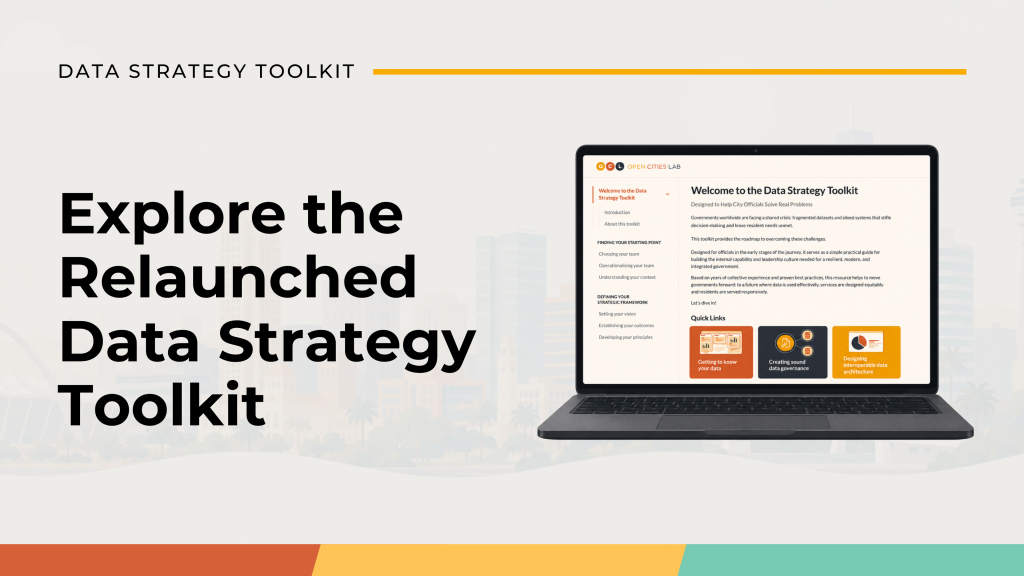
A practical guide for public institutions ready to strengthen their data foundations We’re excited to share the relaunched Data Strategy Toolkit: a practical guide for local governments and public institutions working to make better use of data. Across our work with municipalities through the MijiBora Community of Practice, we have seen a common challenge: the […]
Open Cities Lab Joins the Digital Public Goods Alliance to Advance African-Led DPI Implementation
Open Cities Lab (OCL) is pleased to announce that we are joining the Digital Public Goods Alliance (DPGA), a UN-endorsed multi-stakeholder initiative working to accelerate the discovery, development, use, and investment in digital public goods that help achieve the Sustainable Development Goals. Joining the DPGA reflects OCL’s commitment to strengthening open, interoperable, and locally owned […]
Growing a Community of Africa’s Digital Doers

All across Africa, in cities, towns, innovation hubs, government offices, and community spaces, people are quietly and consistently building the digital foundations of our continent’s future. They are integrating systems, designing services, writing the code, testing the tools, and translating ambition into working infrastructure that people can rely on. These are the people at the […]
The Week That Was

At the beginning of November, we experienced one of those truly serendipitous moments in the OCL calendar. It was a “divide-and-conquer” type challenge to be everywhere, all at once – but we did it! The stages, conversations and impact we experienced was humbling, and a testament to a decade of showing up for African cities […]
The Future is Digital, Public, and African

Open Cities Lab is deeply invested in Digital Public Infrastructure (DPI) as a pathway to more inclusive, responsive, and rights-based service delivery in Africa. Megan Wadge, our CEO, reflects on attending a high-level dialogue hosted by the South African Presidency, where DPI was explored as a catalyst for growth, trust, and regional integration. We’re building […]
Beyond the Buzzword: Making Responsible Tech Actionable

When we talk about responsible technology, we mean building tech that helps people while minimising harm. Our Responsible Tech Toolkit is a practical guide to making ethical, inclusive, and just decisions at every stage of civic tech development. It’s still a work in progress, evolving with insights from our community, and we’d love your input. […]
Everybody wants a portal… what we learned about what users actually need.

The South African Cities Open Data Almanac (SCODA) is a program that is a partnership between Open Cities Lab and the South African Cities Network. SCODA is a city-centric data portal that provides evidence, analysis (through the SCODA Codebook and Demographic Modeller ) & insights on current and comparable information about South African cities to […]
Urban Data and Technology Ecosystem

But what is “urban tech”? The Open Cities Lab team gets to work with a bunch of different types of people, who all recognise that technology can be put to use in solving problems for people who live in cities. This takes different forms, and sometimes it can get a little murky. When do you […]
What have your experiences been leading up to the South African Local Government Elections 2021?

Abigail Kemper from Open Cities lab interviews mother-daughter duo, Liz and Sarah, about the lead-up to the South African 2021 local municipal elections and their experiences using the MyCandidate.opencitieslab.org tool to find the candidates contesting in their ward. Before now, there was no easy way of knowing who you could possibly vote for. For most […]