
A reflection on what a frustrating business registration process reveals about disconnected government systems by Amollo Ambole, Strategic Partnerships Lead at Open Cities Lab.
I recently set out to register as a consultant to provide services to a government department in Kenya, assuming it would be a fairly straightforward one-time process.
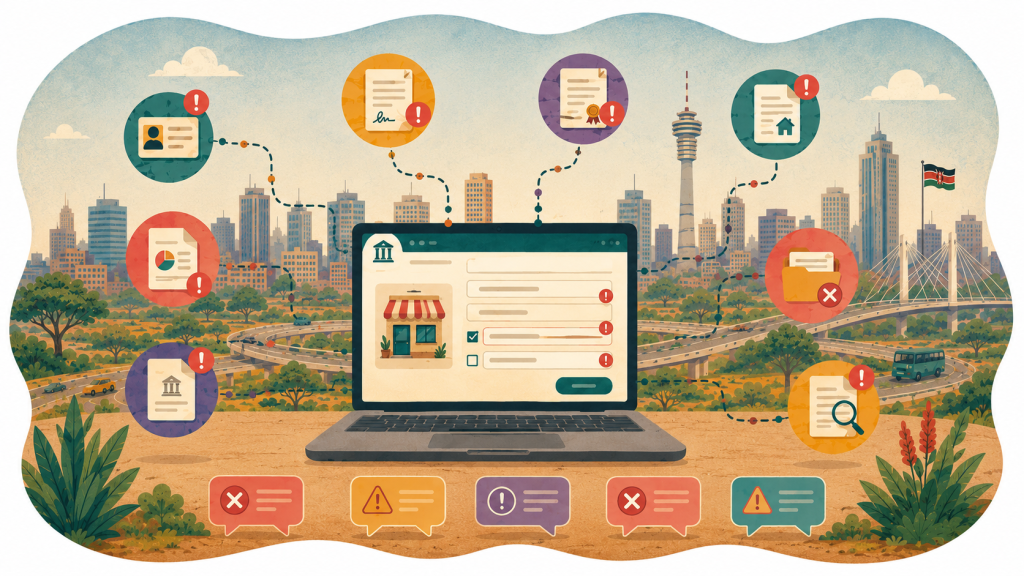
Instead, it became a trail of registrations, certificate uploads, approvals, and repeated verification processes across multiple platforms.
At every stage, I was asked for the same information all over again: company registration, tax compliance, ID details, addresses, and supporting documents.
At one point, my application on one of the platforms kept failing because I was entering the wrong number. The document had both a reference number and a certificate number, and I was entering the reference number. I eventually had to physically visit a government office, where someone solved the issue in seconds.
Then came the next platform, which spent the entire day rewarding me with error messages. I even called the contact number listed on the website, only to be told that the office in question does not actually use that number. What?
At that point, I abandoned logic and turned to magical thinking. I convinced myself that maybe the platform functions best early in the morning. So I woke up before sunrise to try again and somehow… It worked!
The experience left me thinking deeply about what a digital government should actually feel like.
Because this is not just about inconvenience.
It is about the invisible burden we place on citizens and businesses when public systems do not speak to each other. It is about how people become the bridge between disconnected institutions, carrying documents, verification numbers, and processes from one platform to another.
At Open Cities Lab, we often talk about digital transformation as something much bigger than simply putting services online. Transformation happens when systems are human-centred and designed around how people actually move through institutions.
The One-Touch Government
A one-touch government is where verified information only needs to be submitted once.
A government where multiple systems can securely validate and share information instead of repeatedly asking people to upload the same documents.
A government where citizens experience one connected journey instead of fragmented processes stitched together by human effort.
Many governments have made important progress in digitising public services. But the next frontier is not just more digital platforms. It is about connected, interoperable systems.
And after this experience, I want it more than ever.
What interoperability looks like in practice
My experience is just one version of a journey that millions of Kenyans, and people across Africa, navigate everyday when they engage with government services.
Registering a business. Applying for a permit. Accessing a social service. Submitting compliance documents.
When I shared this experience with my colleagues at Open Cities Lab, it opened up a deeper conversation about interoperability: what it means for government systems to speak to each other securely and seamlessly.
Wasim, OCL’s Chief Technology Officer, explained it simply. Interoperability is about building the layers that allow systems to safely exchange trusted information. This can include shared registries, which act as reliable sources of key information; APIs, which allow systems to request and share specific data; and data exchange platforms, which help different institutions verify information without forcing citizens to carry the burden from one platform to the next.
When these layers are missing, people become the connectors. We upload the same certificate again. We copy numbers from one system into another. We travel to offices to resolve issues that should be solved through better system design.
At OCL, we work with governments and public institutions to move from fragmented digital services towards more connected, user-centred systems. This includes helping teams scope, design, build, and implement data exchange platforms that work with existing systems.
If your government systems are online, but still feel disconnected, let’s talk. Send us an email at info@opencitieslab.org to share what you’re working through or request our data exchange capability pack. Together, we can explore what it would take to move closer to a one-touch government.