
A practical guide for local governments ready to turn fragmented data into stronger public systems
Picture this.
You are trying to understand what is happening with water losses in your city, municipality, county, district or local authority – whatever form local government takes in your context.
The issue is urgent. Water is being lost somewhere in the system. Residents are frustrated. Billing may be affected. Maintenance teams need to know where to act. Leadership needs a clear answer.
And, in theory, the data exists.
Customer records sit in one system. Meter readings sit in another. GIS data sits somewhere else. Operational data is stored in yet another platform. Each system holds part of the picture, but none of them easily speak to one another.
So your team starts piecing the story together manually. Someone exports a spreadsheet. Someone else checks a database. Another team confirms the location. A fourth team sends through a different version of the same customer record.
Then the checking begins.
Which record is correct? Which system is the source of truth? Is the meter linked to the right property? Has the issue already been reported? Is the same household appearing twice?
This work is slow, frustrating and easy to get wrong. It pulls officials into long email chains, manual comparisons and repeated follow-ups when they should be focused on solving the actual problem.
For residents, the impact is direct: a leak takes longer to trace, a billing issue takes longer to resolve, or a household is asked for information the government already has somewhere else.
The data is there. But it is duplicated, fragmented and not yet working together in the way public officials – or residents – need it to.
That is where a data strategy becomes practical.
What we have learned from working with municipalities
This kind of challenge is not hypothetical.
In Ugu District Municipality, data about a single customer or resident was housed across four different systems: CRM, SCADA, GIS, and revenue and meter readings. These systems could not easily be cross-referenced, making it difficult to build a unified view of customers, areas, resource leakages and billing issues.
The technical solution seemed straightforward: connect these systems through an integrated dashboard so officials could see the full picture and act more quickly.
But before the dashboard could be built, the team needed access to data, even small sample datasets. That access could not move forward without a formal service agreement. A practical technical requirement became a legal and institutional hurdle.
Still, the process created lasting value. Ugu mapped its foundational data, created a data registry, identified metadata and ownership, developed its first data strategy, and established a Data Working Group.
The experience reinforced an important lesson: digital transformation is not only about building tools. Sustainable change depends on leadership buy-in, clear ownership, trusted access processes, governance structures, internal capacity and practical use cases that solve real problems.
Across our work with South African municipalities through the MijiBora Community of Practice, we have seen this lesson play out repeatedly. While every municipality has its own context and constraints, successful data initiatives are built on strong foundations that allow people, processes and technology to work together effectively.
The Data Strategy Toolkit grew out of these experiences. Developed through collaboration, testing and iteration with nine South African municipalities, it reflects practical lessons from teams working to strengthen data governance, improve service delivery and build more resilient public institutions.
What is the Data Strategy Toolkit?
Most teams already know what the problems are. The harder part is knowing where to start, who needs to be involved, and how to move from isolated data work to something more coordinated, useful and sustainable.
We designed the Data Strategy Toolkit to help simplify that journey.
The toolkit helps public institutions build the culture, strategy, governance and technical foundations needed to use data effectively. While it was developed with local government practitioners in mind, it can be adapted by any public institution seeking to better align its people, systems and processes.
Rather than prescribing a rigid framework, the toolkit provides practical guidance that teams can adapt to their own context, priorities and capacity.
It helps teams answer questions such as:
- Where are we starting from?
- Who needs to be involved?
- What data do we have, where does it live, and who does it serve?
- What problems should we prioritise first?
- What governance and ownership structures need to be in place?
- How do we move from strategy into implementation?
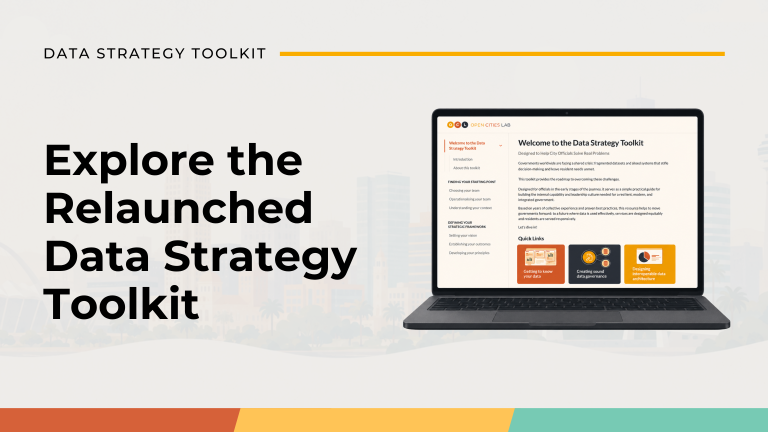
The toolkit walks teams through the core building blocks of a data strategy, including establishing a cross-departmental team, setting a shared vision, conducting a data inventory, strengthening governance practices, improving interoperability, building a sustainable data culture, and translating priorities into an implementation roadmap.
It also includes a Data Maturity Assessment and a Use Case Framework to help teams understand their current level of data maturity and identify projects that can deliver meaningful impact.
Why a data strategy matters
A data strategy creates a shared understanding of what data exists, where it sits, who is responsible for it, and how it can be used more effectively.
It helps organisations establish the foundations that make better use of data possible: clear roles and responsibilities, trusted access processes, shared standards, sound governance and practical ways of applying data to solve real-world challenges.
With the right foundations in place, data becomes more than a collection of systems and spreadsheets. It becomes a resource that supports better decision-making, stronger coordination and improved public services.
Start where you are
Every organisation is starting from somewhere different.
Some teams are still building awareness of the value of data. Others have internal champions but need support turning that momentum into a coordinated strategy. Some are ready to move into implementation and deliver priority projects.
The important thing is understanding where you are today and identifying the next steps that will help you move forward.
The Data Strategy Toolkit is designed to meet teams where they are. It provides practical guidance for understanding your current data environment, identifying gaps, establishing governance foundations and developing a roadmap for improvement.
For organisations that need additional support, we also offer advisory services, peer learning opportunities through the MijiBora Community of Practice, and implementation support for priority initiatives.
Explore the Relaunched Data Strategy Toolkit
If your city, municipality, county, district or local authority is working with fragmented systems, duplicated data, unclear ownership or data that exists but is difficult to use, the Data Strategy Toolkit is a practical place to start.
We invite you to explore the toolkit with your team and use it to begin the right conversations: what is already working, where the gaps are, and what kind of support could help you move forward.
As a next step, you can also take the Data Maturity Assessment to better understand your current data environment and readiness. You do not need to have everything figured out before you begin.
Explore the Data Strategy Toolkit here.
Take the Data Maturity Assessment here.
A note of thanks
The Data Strategy Toolkit has been shaped through the Urban Resilience Programme, supported by the UK Foreign, Commonwealth & Development Office, and through the practical learning, collaboration and generosity of the nine South African municipalities that have been part of this journey: City of Cape Town, eThekwini Municipality, Ugu District Municipality, Ray Nkonyeni Municipality, KwaDukuza Municipality, uMhlathuze Municipality, Msunduzi Municipality, Nelson Mandela Bay Municipality and the City of Tshwane.
We are grateful to the municipal teams who shared their time, challenges, insights and experiences through the MijiBora Community of Practice and related advisory support. Their openness has helped turn this toolkit into a resource grounded in real local government contexts, and one that we hope will support many more cities, municipalities, counties, districts and local authorities as they build stronger data foundations for better public service delivery.